The New Assignments
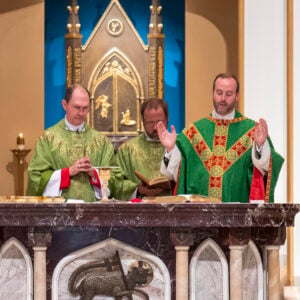
This is the time of year for new priestly assignments from Bishop John Folda of the Diocese of Fargo. Bishop Folda is very thoughtful in making assignments. Every priest is given an chance to share his own personal discernment each year, and he extensively consults a group of eight priests who serve as the Deans of the eight geographical sections of the Diocese called Deaneries. New assignments are a result of this prayerful process, but ultimately made by the Bishop himself.
Here is a summary of the new assignments that affect our parish, taking effect on June 24, 2026:
- I will begin serving as Vicar General of the Diocese of Fargo while continuing as your Pastor.
- Fr. Joseph Littlefield will continue with us a second year as a full-time Parochial Vicar.
- Fr. Robert Keller will join us as a half-time second Parochial Vicar alongside his work as a Theology Instructor at Shanley High School.
- Fr. Kyle Metzger and Fr. Slattery will continue living in residence at our parish in their roles at Shanley High School, Sacred Heart Middle School, and the Vocations Office.
- Mr. Paul Zach, a seminarian for the Diocese of Fargo, will be ordained a Deacon on Friday June 5, 2026 and assigned to us for the new “Vocational Synthesis Stage” of priestly formation, introduced by the Vatican’s 2016 document The Gift of the Priestly Vocation. That document mandates a minimum six-month period for transitional deacons to live and serve in a parish, focused on pastoral integration and growing into priestly identity, distinct from academic seminary life. Nearly Deacon Zach will be with us for June, July, and August 2026 and again for January, March, and May of 2027 before his priestly ordination.
We will have a full Rectory this coming school year with six men, but its great to have a strong community of clergy living and praying together.
Initial Reflections
Well, there is a lot to cover.
First — I am not leaving Sts. Anne & Joachim; I will remain your Pastor. This new role is added in addition to my service to our parish. I also have come to learn that the commute to the Diocesan offices isn’t that bad.
This will be similar to Msgr. Joseph Goering serving both as the Rector of St. Mary’s Cathedral and Vicar General the past 17 years. He has done an outstanding job as Vicar General, and I am confident our transition with this Diocesan role will go well.
Second — I am not stepping into something completely unknown. I served seven years as the Chancellor of the Diocese of Fargo from 2008-2015, and know well what kind of work this will be. There will be new challenges, but also new ways to help and serve the Lord Jesus and his people.
When a bishop asks a priest to help him in the shepherding of the Diocese, the answer, said in freedom and in faith, is yes. I am ready to begin learning again what it means to serve in this new role. It will be a significant responsibility, but also a significant invitation to lay down one’s life to bring light, peace, and ultimately God’s own love to many people, circumstances, and needs.
What Stays the Same
What will change for the day-to-day experience of our parishioners? Not much. Masses, confessions, funerals, weddings, baptisms, the school board, our ministries — all of it continues. I will be away from the parish on some days for diocesan work, and I will lean more on our Priests, Deacons, and staff, who already carry so much.
A Time of Transition
For many who work with me day to day, the change here will be real. My calendar is going to shift, some decisions will take longer to make their way to me, and the rhythm we have built together as a team on our parish staff will need adjustment. I am not going to pretend otherwise. If something is not working, or a challenge surfaces that I have not seen, I am all ears. I want our parish to remain a community where staff can speak honestly with one another and with me. I would rather hear the hard thing early than discover it late. Practically, I will be spending two days each week in the Parish Office and two days at the Diocesan offices in the Pastoral Center, alongside my usual two days of weekend parish ministry, with some give and take as the work requires.
The Vicar General’s Role
You may be wondering what a Vicar General actually does. Fair question. Most Catholics have never had reason to think about the office, and, honestly, it is more of behind-the-scenes sort of work. Here are a few things worth knowing.
The Vicar General is the Bishop’s principal deputy — in older language, his “alter ego.” He serves as second-in-command, with executive authority across the whole Diocese, attending to its day-to-day life. The closest secular parallel is a chief operating officer. The point of the office is not to pile up administration for its own sake, but to make sure the structures of the Diocese remain in service of God’s faithful — so that paperwork never takes precedence over people, and so that the Priests who serve you and other parishes are helped, not hindered, in their care of souls.
By law, a Vicar General must be a priest, and he carries the title of local Ordinary — the canonical term for those who exercise ordinary executive authority in a diocese. He is to keep the Bishop closely informed, to bring the more important matters to him, to stay in frequent communication, and to act always according to the Bishop’s mind and intention. The office is built on communion — on standing with the Bishop, not apart from him. I have worked closely with Bishop Folda in many different ways during his thirteen years of service to us, and I am looking forward to collaborating more closely with him for the glory of God and the sanctification of souls. I want to thank Bishop Folda for his fatherly care and for entrusting me with this new role.
An Ancient Office
The office itself is not new. Its roots reach back to the fourth century. The Second Vatican Council called it “the most important office in the diocesan curia,” and the 1983 Code of Canon Law made it a required part of every diocese’s structure. While there will be new duties for me, I am stepping into a role the Church has tested and trusted for a long time. Some great saints have served in this role, including St. John Bosco, St. Francis de Sales, St. Charles Borromeo, and St. Anthony Mary Claret. I think I’ll be seeking their prayers in the months ahead.
Vicar for Clergy
A big part of my new role will be to serve our Priests and Deacons as the Vicar for Clergy, which has been a major focus of the Vicar General in our Diocese in years past. In a Diocese as large and spread out as ours, clergy can sometimes feel far from one another and have to face the challenges of parish leadership and priestly life on their own. The Vicar for Clergy is there to walk alongside them — helping with assignments and transitions, supporting their ongoing formation and retreats, and being available for the day-to-day questions that come up in ministry. Some of that is administrative. A lot of it is simply being a brother Priest to call when the road is long. Our Priests and Deacons give so much of themselves for our people, often quietly and faithfully, and amid the ordinary human challenges of life. It will be a privilege to be of service to them. I love being a priest, and I want to help our priests flourish as spiritual fathers in our parishes, and our deacons excel in their role of service and as heralds of the Gospel.
Moderator of the Curia
In the Diocese of Fargo, the Vicar General also serves as the Moderator of the Curia, which means I will also have a role in the operations of the Diocesan Pastoral Center next door to our parish. The “Curia” of the Diocese is the official canonical term for the offices and roles that assist the Bishop in his administrative work, and by extension, the clergy and laity that assist the Bishop more broadly with his work and ministry.
One great gift and challenge we have as Catholics is a unity of faith and charity that is not manifest as merely an invisible unity, but deeply incarnate, expressed and lived in a visible unity of institutions and relationships. The Moderator’s role within the Diocesan Curia is to assist the Bishop in promoting and ensuring “…that diocesan structures should always be at the service of the good of souls and that administrative demands should not take precedence over the care of persons. Therefore, he should see that the operation is smooth and efficient, avoiding all unnecessary complexity or bureaucracy, and always directed towards its proper supernatural end.” (Directory for the Pastoral Ministry of Bishops, no. 177, 2004.)
An Ask, and a Word of Thanks
What I ask is simple: pray for Bishop Folda, pray for our Diocese of Fargo and our priests, and pray for me. The Risen Lord who walked the road to Emmaus with the disciples walks with this Diocese too, and I have placed my trust in Him during this transition. Over the past couple years, I have felt a closer connection with certain saints as well. St. Vincent de Paul, St. Bernard of Clairvaux, and St. John Chrysostom have been sources of consolation in the communion of saints. I will be seeking their intercession, along with my usual favorites of St. Thomas Aquinas and Thérèse of Lisieux.
I am grateful for each and every one of you in our parish family. You are a blessing to Sts. Anne & Joachim, and it is a gift to serve you. I know your dedication to the Catholic faith, the mission of the Gospel, the life of prayer and service, and our growing parish community. I am genuinely looking forward to continuing as your Pastor alongside this new work.
Peace of the Lord Jesus,
Fr. Luke Meyer
Pastor