Lifted Up
 The mystery at the heart of the Ascension is not a departure. It is a homecoming.
That sentence is harder to believe than it sounds. For most of us, the Ascension is the awkward feast forty days after Easter and ten days before Pentecost — the one when Jesus “leaves.” We say it that way at coffee and donuts; sometimes our hymns even say it that way. And yet the Church has never said it that way. Fr. Jean Corbon, O.P., in his great book The Wellspring of Worship[1], pays great attention to the Ascension. Our Deacons know this book well, as its a big part of their training. I myself had a profound encounter with his Chapter 4 a couple of years ago, during a daily Holy Hour. Corbon thinks we have lost something the first Christians had. What did they have?
What the Early Church Saw
They had pictures, and they put them up. In the fourth and fifth centuries, when the Church first began to compose images of the Ascension, she did not put them in the side aisles. She put them in the dome. Corbon writes warmly of these early basilicas:
We can only wonder at, and try to recapture for ourselves, the insight shown by the early Christians and by Christians down to the beginning of the second millennium, who placed the Christ of the Ascension in the dome of their churches. When the faithful gathered to manifest and become the body of Christ, they saw their Lord both as present and as coming. He is the head and draws his body toward the Father while giving it life through his Spirit.[2]
The early Church looked up at the dome of her own church and saw the Ascension — not as a departure but as a gathering. The Lord both present and coming. The head still drawing His body upward into the Father’s house. The Ascension was the visual key that held the Mass together.
An Image We Now Have Again
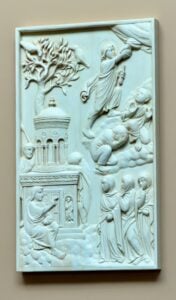
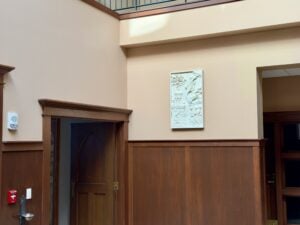
A new wood carving has just come to Sts. Anne & Joachim Catholic Church, and it stands inside that same tradition. It is a careful translation of one of the most remarkable objects ever made of ivory: the so-called Reider-panel, carved in Rome (or possibly Milan) around the year 400 and now housed in the Bayerisches Nationalmuseum in Munich. The little ivory is only seven and a half inches tall and barely a quarter inch thick, and yet the museum calls it “undisputedly the best work in ivory surviving from Late Antiquity.”[3] Our wood version comes from the ALBL Holzschnitzerei in Oberammergau, Bavaria, a workshop in the same region that holds the original.
To understand what is now on our wall, it helps to read it.
What the Carving Shows
Read the panel from the bottom up.
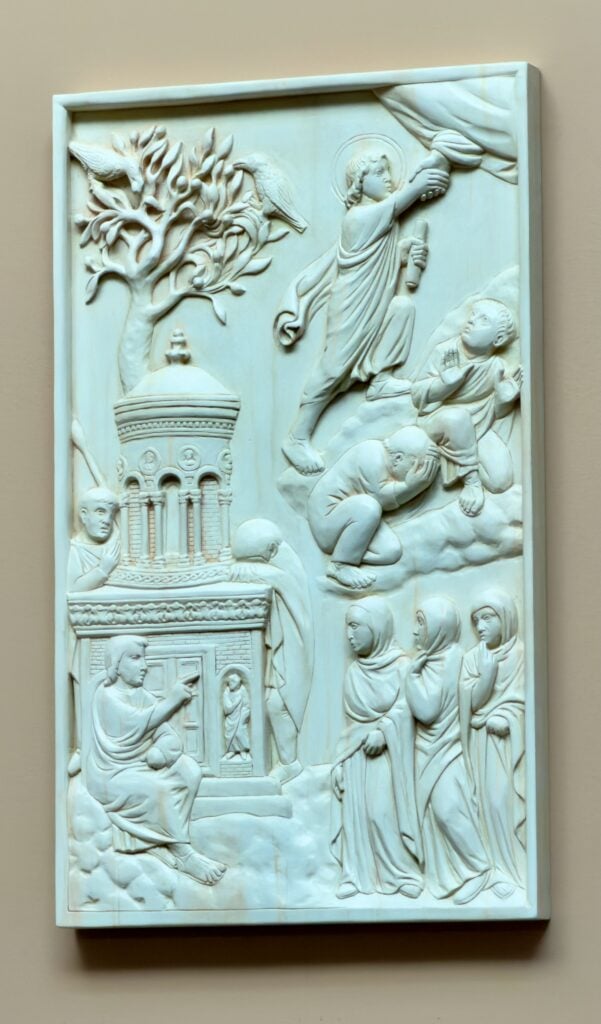
On the lower right, three women approach the tomb at dawn. They are Mary Magdalene and her companions, in the long-veiled garments of late Roman matrons. The carver does not give them the jars of ointment that medieval painters will later place in their hands; they are simply the women who came at dawn. Their gestures — the hand raised toward the mouth, the veiled face — belong to the fourth-century Christian vocabulary of restrained sorrow, the inward grief that St. John Chrysostom and his contemporaries taught in place of the dramatic public lamentation of pagan funerals.
The tomb itself is not a rough cave but a small Roman mausoleum with a colonnaded drum and a dome. This is not artistic license; it is a memory. Constantine had built such a shrine — an aedicula — over the actual tomb of Christ at the Church of the Holy Sepulchre, and pilgrims of the fourth and fifth century would have known it well.[4] The carver is showing us not the tomb as the women found it but the tomb as the Church remembered and venerated it.
In front of the mausoleum sits the angel of Matthew’s Gospel — calm, almost casual, like a guide who has been waiting. At the corners, two soldiers slump like men “struck with terror” (Mt 28:4). On the left, an olive tree — the Mount of Olives, where the Ascension itself took place — climbs the full height of the panel, undercut in the original ivory so finely that its branches stand free of the background. Birds bend in the branches to feed on the fruit. Already, in the lower half of the panel, the Resurrection is offered as food.
Now look up.
In the upper right, a young, beardless Christ climbs what looks like the side of a mountain. His left hand carries a scroll; His right hand is raised. And from a cloud above Him, another hand reaches down and takes His.
The Gospels of Luke and Mark describe the Ascension in the passive voice: “He was taken up into heaven.” The carver has preserved that passive in the most striking way possible. Christ is not floating; He is not being launched. He is being taken and welcomed. The hand from the cloud is the hand of the Father. The art historian Herbert Kessler has observed that the carver gives us a Christ who climbs — a choice rooted in the older Western liturgy of Ascension Day, which paired the New Testament account with the theophany of Moses on Sinai (Ex 19).[5] The Christ of the panel is the new Moses, but unlike Moses, He is not climbing alone, and He is not climbing to receive a covenant. He is being received into one.
Just below the cloud, two crouched figures appear to be unable to look up. Older readings call them apostles blinded by the light. More recent scholarship has suggested they are specifically Peter and James, the two disciples whose vision of the Ascension is described in an apocryphal early-Christian text called the Apocryphon of James, in which the two of them are said to have “sent their hearts up to heaven.”[6] Either reading is appropriate, and both may be at work. They are the figures of those who watched Christ go. They are also, for us looking at the panel now, an icon of what we ourselves are asked to do: lift our hearts.
The Father’s Joy at the Return of the Son
It is here that the panel stops being only beautiful and becomes also theological — and here that Corbon helps us most.
For Fr. Corbon, the Ascension is not a parting. “In His Ascension,” he writes, “Christ did not at all disappear; on the contrary, He began to appear and to come.” The Lord “has not gone away to rest from His redemptive toil; His ‘work’ (Jn 5:17) continues, but now at the Father’s side, and because He is there He is now much closer to us.”[7]
The Ascension and Pentecost, Corbon insists, are one mystery seen from two sides — “a continual ascension and Pentecost” — and what the Father and the Son still go on working is, in his lovely image, “the fontal liturgy in which the life-giving humanity of the incarnate Word joins with the Father to send forth the river of life.”[8] Fontal, as in fountain. The two hands meeting in the cloud at the top of the panel are not a closed circuit. They are the fountainhead of the Mass.
But Corbon presses one step further, and hands us the key to reading the central gesture of the carving. The Ascension, for him, is above all the homecoming of a Son to a Father who has been waiting. “Only when the life that burst from the tomb had become liturgy could the liturgy finally be celebrated — only when the river returned to its fountainhead, the Father.” And the Father at the fountainhead does not stand impassive: “For the liturgy is the celebration of the Father’s joy.”[9]
What Father’s joy? Corbon does not flinch:
Transcending the parables in which Jesus gave a glimpse of this jubilation (“There will be more rejoicing in heaven over one sinner repenting”: Lk 15:7) is the reality now attained: the eternal joy of the Father at the return of his beloved Son. The latter had gone forth as the only Son; now he returns in the flesh, bringing the Father’s adoptive Sons: “Look, I and the children whom God has given me” (Heb 2:13).[10]
This is what the hand from the cloud is doing. It is not a generic divine intervention. It is the welcome of a Father reaching out to embrace a Son who has been gone a long time, who has been at terrible work, who has carried out His mission with courage — and who is bringing the rest of His family home with Him. “The Ascension of Jesus,” Corbon writes a couple of pages later, “is the reflux of the river of life to its fountainhead, the return of the Word to the heart of the Father after having accomplished its mission.”[11]
The empty tomb at the bottom of the panel is the cost of the mission. The joined hands at the top are its reward. The olive tree on the left, with its feasting birds, is the visible proof: the river has already begun to flow, and the children of God have already begun to feed.
A Homecoming We Are Invited Into
When you next walk past the carving, give it a moment. Read it from the bottom up, the way it was made to be read. Find the women, the angel, the soldiers; the birds at their meal in the Tree of Life; the two disciples beneath the cloud, sending their hearts up. Then lift your own eyes — slowly, the way they cannot — to the place where two hands meet in a cloud, and remember what those hands are doing. The Father is welcoming home His beloved Son, who carried out His mission with courage and now shares the joy of the victory.
And He is not coming home alone.
We are grateful: to the carvers in Oberammergau whose hands made this piece; to the donations that made the commission possible; and to the small ivory in Munich that has waited sixteen hundred years to teach a parish in Fargo, North Dakota, this kind of thing.
See you at Mass. The Father is waiting to share his joy.
Peace of the Lord Jesus,
Fr. Luke Meyer
Pastor
[1]Jean Corbon, OP, The Wellspring of Worship, trans. Matthew J. O’Connell (San Francisco: Ignatius Press, 2005), 59. (Chapter 4: “The Ascension and the Eternal Liturgy.”)
[2]Corbon, Wellspring of Worship, 60.
[3]Bayerisches Nationalmuseum, Munich, Inv.-Nr. MA 157.
[4]Richard Krautheimer, “Introduction to an ‘Iconography of Mediaeval Architecture,’” Journal of the Warburg and Courtauld Institutes 5 (1942): 1–33; on the Reider-panel as a tool for meditative pilgrimage, see Lindsey Hansen, “Acts of Witnessing: The Munich Ivory of the Ascension, Medieval Visuality and Pilgrimage,” Hortulus 7.1 (2011).
[5]Herbert Kessler, “Narrative Representations,” in Kurt Weitzmann, ed., Age of Spirituality (New York: Metropolitan Museum of Art, 1979), 454.
[6]Hansen, “Acts of Witnessing,” with reference to the Apocryphon of James.
[7]Corbon, Wellspring of Worship, 61.
[8]Corbon, Wellspring of Worship, 58–59 (continual ascension and Pentecost); 62 (the fontal liturgy).
[9]Corbon, Wellspring of Worship, 64–65.
[10]Corbon, Wellspring of Worship, 65.
[11]Corbon, Wellspring of Worship, 67.