Why a new setting?
Lent is quickly approaching, and as we normally do, we will change to a different Mass Ordinary setting as the liturgical season changes. When we change liturgical seasons, we try to highlight the changes within our celebration of Mass. This year, we’ll be singing our first ‘new’ Mass Ordinary since we learned the Mass of St Phillip Neri a few years ago.
Beginning on Ash Wednesday, we will sing “Missa Mater Dolorosa,” written by Fr. Michael O’Connor, O.P., who is the Director of Music at Mount Saint Mary’s Seminary. One of our Diocese of Fargo seminarians, Deacon Taylor Ternes (you may remember Deacon Taylor was with us this past summer) is completing his studies and formation for the priesthood there under Fr. O’Connor’s tutelage! I think this setting offers a great example of being ‘practically singable’ for all, and marked with a sacred sound that fits the liturgical season quite well.
During the season of Lent, the Catholic Church asks us to make some changes to the music at Mass. For example, we do not sing the ‘Gloria,’ or ‘Glory to God’ during Lent, nor do we sing ‘Alleluia’ before the reading of the gospel. (GIRM 53 & 62) In addition, instrumental solos are not permitted during Lent. (MS 66) We may be tempted to say that the music becomes ‘muted’ during Lent, but that’s not quite accurate either! True, the organ does not sound at the heights of its volume and tones, but this should serve to emphasize the human voice– the instrument God created! In fact, GIRM 313 states “In Lent the playing of the organ and musical instruments is allowed only to support the singing.” So, we continue to play the organ in order to support the singing of all the people. Logically, we can then deduce that the Church wants us to keep singing and praying together, united in our sacred song. The organ may not resound with all of its might, but we still can!
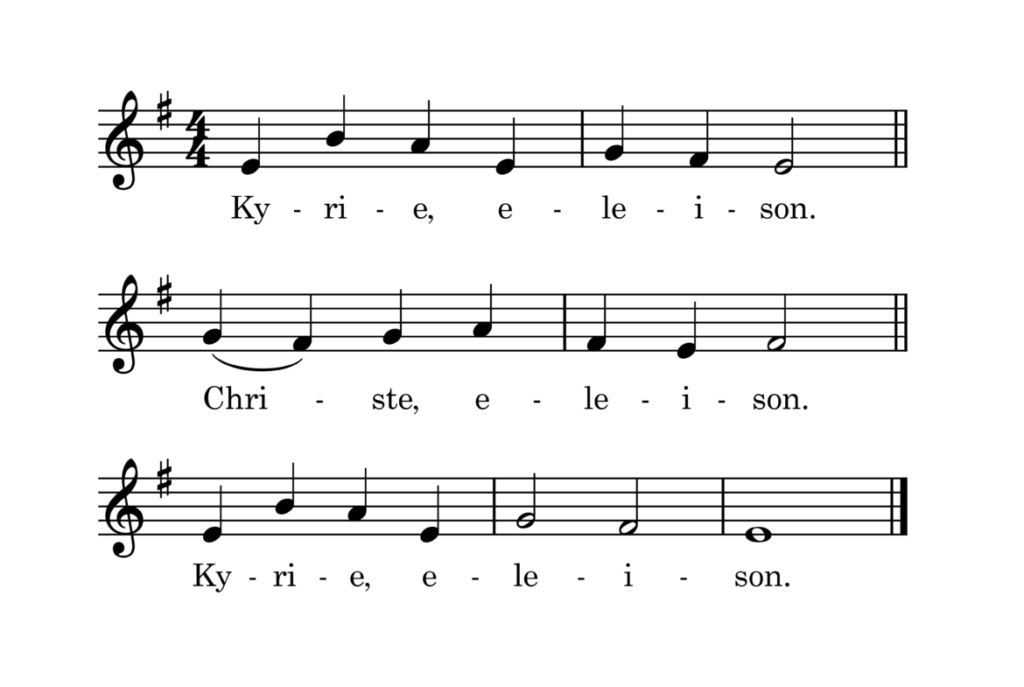
With that in mind, this setting of the Ordinary fits well, because there is a beautiful simplicity to the music that lends itself well to congregational singing. The repeated melodic ideas between movements make learning much quicker, and allow us to offer our voices up in prayer more readily, as a ‘sacrifice of praise.’ The rhythm is quite simple and the range of notes is only from E-natural at the bottom of the staff to C-natural just above the middle of the staff.
What's in the music?
There are only two melodies that Fr. O’Connor uses for each movement of the Mass, so even though there are five separate parts, there are really only two melodies to learn! The Kyrie is in Greek, and everything else is in English. Here are the 5 movements we will be singing:
- Kyrie (Lord, Have Mercy)
- Sanctus (Holy, Holy. Holy)
- Memorial Acclamation B (When We Eat This Bread)
- Amen
- Agnus Dei (Lamb of God)
(Note: in Lent, we do not sing the Gloria)
How can I prepare?
I have made a simple practice video to demonstrate this Mass setting, and rest assured that our musicians have been looking at the music in advance to prepare to lead us well. As with anything new, it will take a little time to adjust, but if you pull out the aid in your pew for the Ordinary each week, you’ll learn it in no time!
NB: This is an ‘unlisted’ link for YouTube
If you have any questions about this music for Lent, please reach out! I continue to enjoy being a part of this wonderful community that sings the praises of God with such beautiful devotion. From daily Mass to the highest of Sunday solemnities, it is invigorating to pray and sing with all of you. Many blessings to you all!
-Patrick McGuire