The dawn of a new liturgical year is upon us! And with it, we will begin singing a new Mass Ordinary for the season of Advent through the winter. This new Mass Ordinary is called the Mass of the Immaculate Conception, written by Dr. Peter Latona.
Why do we make changes in each season?
Here at Sts. Anne & Joachim, we have made it our custom to sing a different musical setting of the Ordinary of the Mass, in each liturgical season. The ‘Ordinary of the Mass’ are the texts we sing on a regular basis at Sunday Mass:
-Kyrie (Lord, Have Mercy) | Gloria (Glory to God) | Alleluia (Gospel Acclamation)* | Sanctus (Holy, Holy, Holy) | Memorial Acclamation* | Amen* | Agnus Dei (Lamb of God)
By singing a different setting of the Ordinary in each liturgical season, we follow the precedent established by the church in its official books for the music of these texts. In this way, we participate in each liturgical season, emphasizing the rhythm of the liturgical year.
Why this Mass setting specifically?
The Mass of the Immaculate Conception is a modern composition by Dr. Peter Latona, who currently serves as Director of Music at the Basilica Shrine of the Immaculate Conception in Washington D.C. There are three primary reasons for selecting this specific setting:
- During Advent we celebrate our patronal feast day in the United States—The Solemnity of the Immaculate Conception. To sing a musical setting of the ordinary that is dedicated specifically to our patronal feast, written by the director of music at the same national basilica dedicated to our patroness, is very fitting!
- The music in this setting contains many repetitive elements from movement to movement. This makes it easier to learn and participate in! The melody is beautiful, and it is logical writing, which perfectly accomplishes what the Second Vatican Council called for in maintaining “noble simplicity” (SC 34) within the celebration of Mass.
- This setting gives us the opportunity to introduce antiphonal singing in the ‘Gloria’ (Glory to God…) movement.
Mass of the Immaculate Conception Videos
What is ‘Antiphonal singing’ for the Gloria?
‘Antiphonal singing’ simply means that there is a back-and-forth form to the singing of a text. We do antiphonal singing throughout the Mass already: The Kyrie is sung ‘antiphonally’ between the cantor and congregation, as is the responsorial psalm, gospel acclamation, and communion chant! We will now introduce this style of singing to the Gloria. The text is broken up into smaller sections for the congregation to sing, which cuts the amount of music to learn in half for the congregation.
This form of singing has been a part of Catholic worship since the early days of the church, particularly with longer texts like the ‘Gloria’ or even the sung ‘Credo’ (yes—a sung Creed!) within Mass. The origins of antiphonal singing go all the way back to St. Ambrose of Milan, who composed many hymns himself and instituted the practice of antiphonal singing with his own congregations.
How does it work?
The idea behind this form of singing is that a longer text is broken up into smaller segments, allowing for greater meditation on the words as the music is sung back-and-forth, or, ‘antiphonally,’ between two groups of people. When one group sings, the other group listens and follows along. This allows the music and the words to wash over them, as in a mini meditation. As one phrase is concluded, the roles now switch and the group that was listening now adds their voices aloud. This back-and-forth is also the standard model for praying the Divine Office together, such as at Morning Prayer or Evening Prayer.
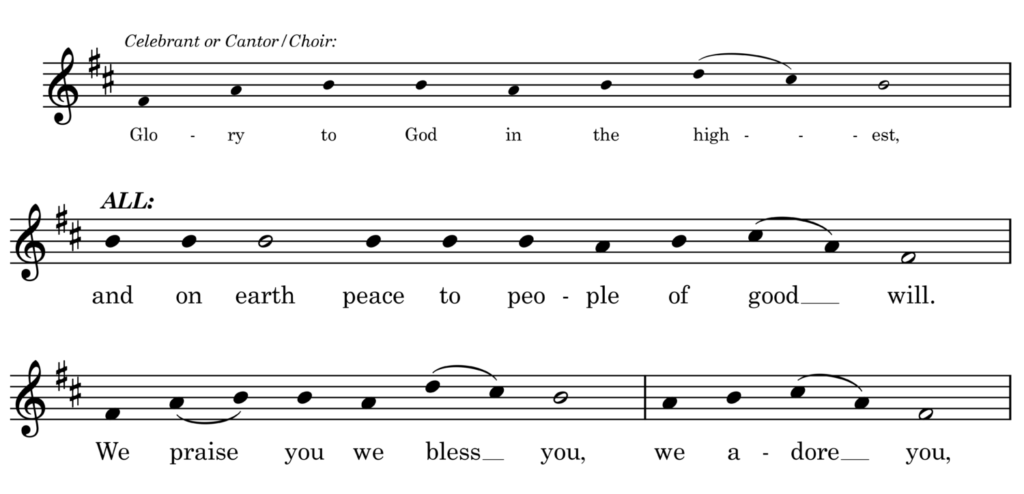
Within our parish, you will see the music aid indicating when the congregation sings, and when just the cantor or choir will sing. The music looks like this:
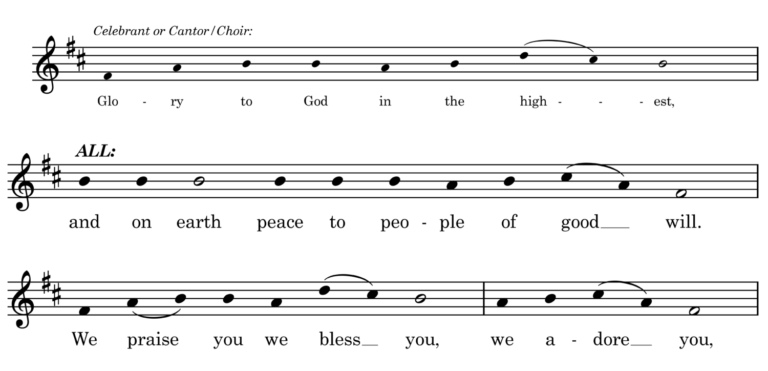
The music for the congregation is larger, with the text “ALL:” indicating where to sing. The music for the cantor/choir is smaller, with the text “Cantor/Choir” indicating where only the cantor or choir will sing. Our musicians have been preparing for a couple of months to lead the way on this, so trust in the musical leadership you hear! The piano or organ will assist in indicating the congregation’s part by the greater volume and depth of sound that supports the congregation, versus a lighter volume & depth of sound for the cantor/congregation.
No Gloria until Christmas!
This new style of antiphonal singing is only for the Gloria (Glory to God) movement. All the other movements will be sung as we normally do! Since we do not sing the Gloria until Christmas (with the important exception of the Solemnity of the Immaculate Conception on December 8th), you will have 4 full weeks to hear the melody, the style, and the harmony that is a part of this setting. By the time we get to Christmas, our congregation will have a solid foundation of exposure to the music that I am confident will lend itself well to participation in short order. As always, something new takes time, but I hope you will jump in with both feet and enjoy this new form of singing to our Gloria each Sunday.