A word on a line quoted recently around the parish — on St. Gregory the Great, purgatory, and ultimately the love of Christ.
Dear Parish Family,
During the month of November, this special time we focus on the last things and praying for the dead, there have been some unclear teachings on purgatory circulating around. Some of you may have heard the line that, “The same fire torments the damned and purifies the elect,” during a recent homily. It is a memorable sentence, and it has been repeated in Catholic books on purgatory for well over a hundred years, and sometimes even attributed to St. Gregory the Great. As it turns out St. Gregory never wrote it. More importantly, the Church teaches something better than what this quote incorrectly proposes. In this post I would like to offer some clarity regarding the Church’s understanding of purgatory.
Where the Line Comes From
The English sentence appears in a number of 19th and early 20th century theological manuals. For instance, in Fr. F. X. Schouppe’s Purgatory Explained by the Lives and Legends of the Saints, a book that sits on a good many Catholic shelves.[1] Schouppe gives as his source a commentary on Psalm 37 — the third of the seven penitential psalms, “O Lord, rebuke me not in thy fury.” For centuries that commentary was printed among St. Gregory’s works. Scholars now agree it is not his. It was most likely written in the eleventh century by an Italian bishop, who is neither canonized nor a Doctor of the Church, Heribert of Reggio.[2]
A similar line — “even as in the same fire gold glistens and straw smokes” — shows up in St. Thomas Aquinas, again credited to St. Gregory. It is really St. Augustine, from the first book of The City of God, and Augustine was writing about the sack of Rome: how one earthly calamity refined the faithful and exposed the wicked. He was not describing purgatory at all.[3]
What St. Gregory Taught
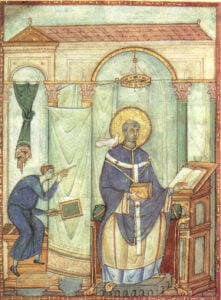
St. Gregory’s real teaching is in his Dialogues, written around the year 593: “As for certain lesser faults, we must believe that, before the Final Judgment, there is a purifying fire.”[4] He grounds it in Scripture — in our Lord’s words about sins forgiven “in the age to come” (Mt 12:32), and in St. Paul’s image of the builder whose work of wood, hay, and straw is burned up, while he himself is “saved, but only as through fire” (1 Cor 3:12–15).
Gregory is careful about it. The fire is for small faults — he names things like idle talk, immoderate laughter, and too much worry over household affairs. And he warns that no one should count on being cleansed after death of what could have been dealt with in this life.
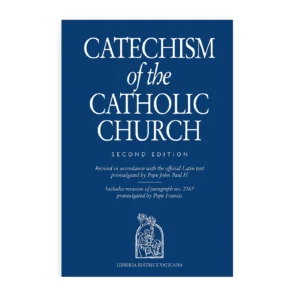
The Church has kept this teaching. The Catechism quotes this very passage from Gregory, in paragraph 1031.
Entirely Different
Paragraph 1031 of the Catechism of the Catholic Church is worth reading in full, because it settles the question:
The Church gives the name Purgatory to this final purification of the elect, which is entirely different from the punishment of the damned. The Church formulated her doctrine of faith on Purgatory especially at the Councils of Florence and Trent. The tradition of the Church, by reference to certain texts of Scripture, speaks of a cleansing fire:
As for certain lesser faults, we must believe that, before the Final Judgment, there is a purifying fire. He who is truth says that whoever utters blasphemy against the Holy Spirit will be pardoned neither in this age nor in the age to come. From this sentence we understand that certain offenses can be forgiven in this age, but certain others in the age to come.[5]
Notice the first sentence. The purification of the elect is “entirely different from the punishment of the damned.” Not a milder hell, and not hell for a limited time — entirely different.
 Purgatory will be empty; all souls there will go to heaven. Purgatory is a kind of suffering by love, in hope and desire. The suffering of hell is hopeless.
This matters more than it might seem. If purgatory is the same fire as hell, then the people we love who have died in Christ are, for a time, in the same place as the lost. That is not what the Church believes, and it is not a thought anyone should have to carry to a graveside.
The Councils of Lyons, Florence, and Trent defined that purgatory exists and that our prayers help the souls there. None of them defined that purgatory is a place, or that its suffering comes from a physical fire. When the Greek bishops at Florence objected to the Latin picture of a material fire, the council simply spoke of “purgatorial punishments.”[6] St. John Paul II put it plainly in 1999: “The term does not indicate a place, but a condition of existence.” Those being purified, he said, “are already in the love of Christ who removes from them the remnants of imperfection.” Purification must be complete — “every trace of attachment to evil must be eliminated, every imperfection of the soul corrected” — but it happens within that love, not outside it.[7]
The Fire That Saves
There is a “same fire” in our tradition, and it is a beautiful one. St. John of the Cross describes God’s love working on a soul “in the same way as fire acts upon a log of wood.”[8] The fire first dries the log and draws out its moisture, then blackens it and makes it unsightly; at last it kindles the log and turns it into fire itself. The light that will one day unite the soul to God, he says, is the same light that at the beginning purges and prepares it.[9] For St. John, the fire that purifies and the fire of heaven are one fire — the fire of God’s love. It belongs with heaven, not with hell.
He even applies the image to purgatory. The fire has no power over a soul except where there is still something imperfect to burn: “These are the material upon which the fire of purgatory seizes; when that material is consumed there is naught else that can burn.”[10] The fire is not there to destroy the soul. It is there to free it.
Pope Benedict XVI took this a step further:
“Some recent theologians are of the opinion that the fire which both burns and saves is Christ himself, the Judge and Saviour. The encounter with him is the decisive act of judgement.”[11]
Before His gaze, Benedict writes, all falsehood melts away, and the touch of His heart heals us “through an undeniably painful transformation ‘as through fire’. But it is a blessed pain.” This is the key insight from the greatest theologian of the 20th Century, and brings Christ and his love back into central focus, which is the source of all good theology.
A Laywoman of Genoa
In his Wednesday catecheses on the saints, Pope Benedict gave a whole audience to St. Catherine of Genoa, and through her, to purgatory. She was born in 1447 into a noble family of Genoa and married young, in an unhappy marriage. In 1473 she had a sudden and overwhelming conversion. She spent the rest of her life serving the sick at the city’s great hospital, the Pammatone, where her husband, converted himself, eventually joined her. Her teaching on purgatory was gathered after her death in 1510 as the Treatise on Purgatory.
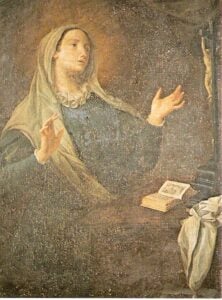
What struck Benedict is that Catherine “does not start with the afterlife in order to recount the torments of purgatory.” She starts from what God’s love had done in her own soul. In her day, purgatory was usually pictured as a place; for her it was “not a scene in the bowels of the earth.” Rather, “it is not an exterior but rather an interior fire.” The soul “is aware of the immense love and perfect justice of God and consequently suffers” — and then “love for God itself becomes a flame, love itself cleanses it from the residue of sin.”[12]
That is the whole correction in a sentence. The fire of purgatory is not borrowed from hell. It is the love of God, felt by a soul that is not yet ready for it and wants to be.
The Fire of Love
St. Thérèse of Lisieux understood this better than almost anyone. On June 9, 1895, she offered herself to God’s merciful love — not to His justice, but to His mercy. A few months later she wrote: “But I also know that the Fire of Love is more sanctifying than is the fire of Purgatory.”[13] She was not making light of purgatory. She was trusting that the same love which purifies the soul after death can do that work now, in a heart that lets it.
That is an invitation for all of us. The love of God that will finish its work in us can begin it today — in confession, in the Eucharist, in the patience and charity of an ordinary week.
So purgatory is not the waiting room of hell. It is the last mercy of a God who will not leave His work in us unfinished. The souls there are not lost. They are already held in the love of Christ.
An Ask
So pray for them this month. Visit a cemetery, have a Mass offered, and pray the Eternal Rest for the people you have lost — and for the souls who have no one left to pray for them. We have a great devotion to the Book of the Dead in our Grief Shrine. There are many ways to remember and pray for the faithful departed. In the end, God’s will for them and for us, is the goodness and glory of beatitude in heaven. May we willingly surrender and respond to such a wise and loving plan.
I am leaning this month on St. Gregory the Great, who gave the Church the words purgatorius ignis and the good sense to use them carefully, and on St. Catherine of Genoa, who saw that the fire is love. And, as always, on St. Thomas Aquinas — who, I note with interest, also credited St. Gregory with a line that was not his — and on St. Thérèse, who trusted that love so completely she hoped to need no other fire.
Peace of the Lord Jesus,
Fr. Luke Meyer
Pastor
[1]F. X. Schouppe, S.J., The Dogma of Purgatory: Illustrated by the Lives and Legends of the Saints (London: Burns & Oates; New York: Benziger Brothers, 1893), 25, citing “In Ps. xxxvii.” Reprinted as Purgatory Explained by the Lives and Legends of the Saints (Rockford, IL: TAN Books, 1986).
[2]Pseudo-Gregory the Great, In septem psalmos poenitentiales expositio, in Patrologia Latina, ed. J.-P. Migne, vol. 79 (Paris, 1849). On its authorship, see Valeria Mattaloni, “Un commento pseudo-gregoriano ai salmi penitenziali, attribuibile a Eriberto di Reggio Emilia,” in Critica del testo e critica letteraria, mediEVI 28 (Florence: SISMEL–Edizioni del Galluzzo, 2020), 97–130.
[3]Thomas Aquinas, Summa Theologiae, Supplement, Appendix II, q. 1, a. 2, sed contra, trans. Fathers of the English Dominican Province (New York: Benziger Brothers, 1948). The source is Augustine, The City of God against the Pagans I.8, ed. and trans. R. W. Dyson (Cambridge: Cambridge University Press, 1998).
[4]Gregory the Great, Dialogues IV.39 (Patrologia Latina 77, 396), as translated in Catechism of the Catholic Church, 2nd ed. (Vatican City: Libreria Editrice Vaticana, 1997), no. 1031. For the full text in English, see Saint Gregory the Great, Dialogues, trans. Odo John Zimmerman, O.S.B., The Fathers of the Church 39 (New York: Fathers of the Church, 1959), Book IV, ch. 39.
[5]Catechism of the Catholic Church, 2nd ed. (Vatican City: Libreria Editrice Vaticana, 1997), no. 1031; the Catechism’s own footnotes are omitted. Compare Congregation for the Doctrine of the Faith, Letter on Certain Questions Concerning Eschatology, Recentiores episcoporum synodi (May 17, 1979), no. 7, which speaks of a purification of the elect “altogether different from the punishment of the damned.”
[6]Council of Florence, Bull of Union with the Greeks, Laetentur caeli (July 6, 1439), in Heinrich Denzinger, Compendium of Creeds, Definitions, and Declarations on Matters of Faith and Morals, ed. Peter Hünermann, 43rd ed. (San Francisco: Ignatius Press, 2012), no. 1304. See also no. 856 (Second Council of Lyons, 1274) and no. 1820 (Council of Trent, Session 25, 1563).
[7]John Paul II, General Audience, August 4, 1999 (Vatican City: Libreria Editrice Vaticana), vatican.va.
[8]St. John of the Cross, Dark Night of the Soul, Book II, ch. 10, no. 1, trans. and ed. E. Allison Peers, 3rd rev. ed. (Garden City, NY: Image Books, 1959).
[9]Ibid., Book II, ch. 10, no. 3.
[10]Ibid., Book II, ch. 10, no. 5.
[11]Benedict XVI, Encyclical Letter Spe Salvi (November 30, 2007), no. 47 (Vatican City: Libreria Editrice Vaticana, 2007).
[12]Benedict XVI, General Audience on St. Catherine of Genoa, January 12, 2011 (Vatican City: Libreria Editrice Vaticana), vatican.va.
[13]St. Thérèse of Lisieux, Story of a Soul: The Autobiography of St. Thérèse of Lisieux, trans. John Clarke, O.C.D., 3rd ed. (Washington, DC: ICS Publications, 1996), Manuscript A, 84v, p. 181.